Sunday, January 5, 2014

The People of Bhutan

The trip of a lifetime is how we describe it. Fortunate to have friends in the Himalayan kingdom of Bhutan--often called Shangri-La--act as sponsors, we were able to avoid the steep mandatory fees and tours. Bhutan allows 22,000 vistors a year--by contrast, 23,000 enter Thailand each day. A week's visit was not nearly enough time, but it was deeply satisfying to be able to experience this mysterious and remote country, which is wedged between India and Tibet. To view our overnight stay at a mountain monastery in October 2009, see my post, "Visit to a Bhutanese Monastery": 
http://expatteacherinthailand.blogspot.com/2009/11/visit-to-bhutanese-monastery.html

Following are selected portraits of the people of Bhutan. They are digitized photos from 100 ASA Kodak negative film. For more information about Bhutan, including the national dress, visit bhutan.com. Next post: Scenes and scenery in Bhutan.

(Photos by the author. All rights reserved. Do not use without permission.)


Many Bhutanese wear traditional clothes. Men wear a "gho", tied at the waist and with an inner pouch for carrying items such as betel nuts that a great many Bhutanese chew seemingly continuously. I tried it. I think one has to develop a taste for it, or enjoy the "buzz" that ensues. Or both. Women wear "kiras", ankle length dresses. All are from hand woven fabric and are quite colorful.

The swirl of colors are everywhere: in the clothing, the ornate and brightly painted storefronts, in the temples and altars. Here a woman with her baby strolls by storefronts in Paro.

This woman wanted me to wait until she had arranged her clothing just right for her portrait. Taken along the main street in Paro.

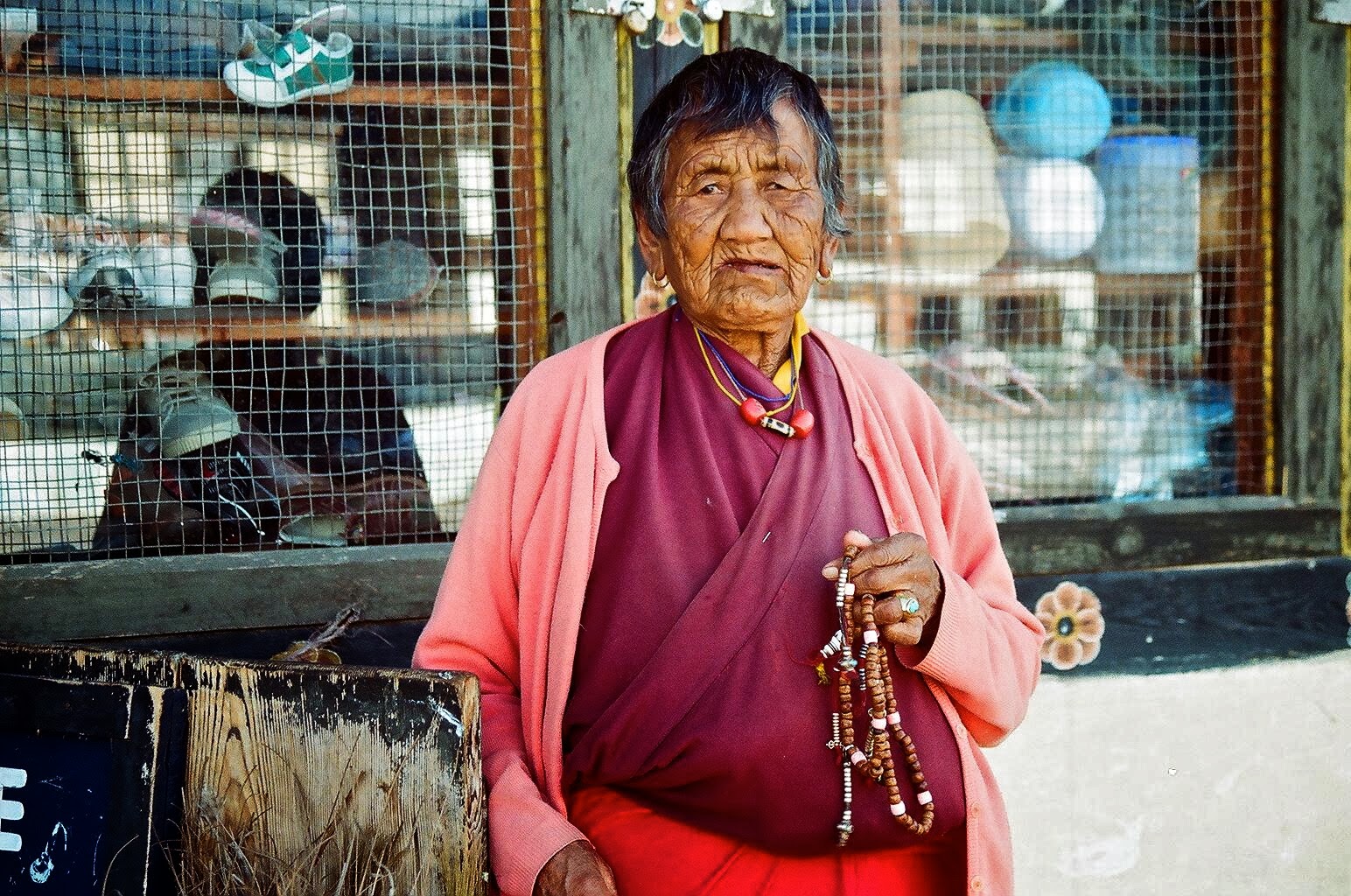
Many Bhutanese Buddhists carry prayer beads, as this woman has. Photo taken in Paro. The deeply lined faces of the elders in Bhutan reflect life in the sun-drenched high altitudes.

This baby and her father exude much of the enjoyment we saw in Bhutan, whose well-being is measured in what they have coined "Gross National Happiness".

A monk rests at a temple in Paro. The ornate painted carvings that enhance the architecture are enchanting.

A young monk at a lakhang, or temple.

At a mountain monastery school, students make ornaments for altars.

Monastery students practice Buddhist chants and songs with traditional mountain horns.

Two of the elders at the monastery. The young man on the right was a student, and is now a teacher at the school.

A young storekeeper peers out as a customer with her sleeping baby looks over the merchandise. Paro.

A curious boy peers at the foreigners in Thimphu, the capital city.

I have found that one of the best places in any country to meet people and to watch their interactions is at the local market. Below are scenes from the fresh market at Paro.


Men examine the quality of ceremonial cymbals.

People bring their home-grown produce to Paro's market and simply spread it out on a sheet. A simple scale is to the right of the vendor.

As in many towns throughout the world, the local market is also the center of the community social scene.

Here vegetables are weighed using a traditional balance scale. The counterweight can be seen in the dish in the foreground.

Smoke from vendors' charcoal grills rises in the early morning mountain air.

A woman keeps warm against the chilly October air.

Customers choose the best quality vegetables and place them on the scale held by the vendor.

Monday, December 30, 2013

Vietnamese Fishing Village, Cambodia

While going through some boxes the other day, I came across some digitized photos (originals taken with 100 ASA Kodak film) that I thought I had lost (Yes, I realize that I need to be more systematic in my filing of photographs, so don't get started on that). It was a wonderful trip down memory lane to a trip taken a few years ago to Cambodia, and fun to sort through and pick out some shots for sharing. I decided to concentrate on one aspect of the trip--most people have hundreds of photos of the classic Khmer ruins of Angkor Wat and its marvelous ancient neighbors, as do I--however, the fishing village of Mui Ne not far from Siem Riap was an interesting side trip that offered a glimpse of a way of life that has remained largely unchanged for centuries.


On the huge Tonle Sap lake, which is a widening of the Mekong River not far from Siem Riap, a village of Vietnamese fishermen sits not on the shore near the lake, but actually on the lake. Mui Ne village is one where everyone packs up and moves as the tide rises during the monsoon season so as not to be stranded far offshore, and then back again during the dry season. The Vietnamese are Cambodia's largest minority, and the tradition of floating fishing villages can be traced to the 1700's. Tourists can take a boat tour of the village and an offshore restaurant, which seems to be way out in the middle of nowhere, surrounded by lapping waves as far as one can see. If you are interested in learning more about the fishing village, tourism, or the Tonle Sap, an Internet search will turn up dozens of sites. 

Photos by the author (2008), all rights reserved. Do not use without permission.
Children all over the world play on whatever type of equipment they can find. In a fishing village it is not surprising that they play in abandoned boats.

Bathing is pretty simple: it's just a splash outside the door.

Returning from the market.

It isn't ipads or TV that piques the curiosity of these boys.

Washing up.

Deliveries and transportation is by boat, deftly moved through the backwater by skilled oarsmen and women.

Even farming is done on the water. Here a villager tends to pigs that are kept in a pen made of tree limbs. 
A typical floating home and its brilliant abstract reflection at Mui Ne in the late afternoon sun.


Relaxing while gently rocking on the waves

Friday, December 6, 2013

Moments in time 2

The second of my posts of random scenes taken as I move through daily life in Thailand (See my first post "Moments in time" from August 6, 2013). Most of these are quick glimpses as I passed by (or as they passed by me). Taken together, they weave an image of the lives of ordinary Thais in what is becoming a more complex society.

Ukelele player in an art studio, Ramkhamhaeng Road

Sometimes trying to solve a problem creates a bigger one.
Near Jatujak 2 market, Minburi.

Monsoon rains come almost daily from May through October. They are warm and heavy, lasting usually only an hour or two, but often bringing flooded roadways. Ramkhamhaeng Road, Saphansung.

Classic Thai sculpture of legendary characters in Thai mythology. Found on the wall in an unused parking lot near a restaurant on Ekamai Road, Wattana.

A woman moves her charcoal grill past street food stalls.
Summakon Village, Saphansung.

Taking a break from selling lottery tickets. Sihaburaniket Road, Minburi.

A lone fishing boat under gathering storm clouds.
Koh Chang (Elephant Island), eastern Thailand.

A knife sharpener carries his whetstone throughout the neighborhood,
seeking customers. Eastern Bangkok.

Clearing storm over Koh Larn (Coral Island) near Pattaya.

Every day, same spot. This woman sells cool drinks on Sukhumvit Road
near the Ekamai bus station.

Gorgeous sunset colors in Summakon Village, Saphansung, eastern Bangkok.
The colors lasted no more than five minutes. iPhone photo.

Traditional wooden shutters, Minburi.

A young girl's special find on the beach. Pu Noi Beach, Dolphin Bay, Pranburi.