Sunday, October 27, 2013

Family farms in Thailand

Rice nearly ready for harvesting.
Thailand is one of the most prolific producers of fresh foods I have seen; despite the country's low average income, people here say that as long as they have rice and fish, no one goes hungry. In a country that receives six months of regular tropical rains, there are two distinct growing seasons, one for crops that thrive in wet soil, and one for those that do well in dry conditions.

I spent a day touring the fields in northeast Thailand (the region known by Thais as "Isan" or "Esan"), where many different crops are grown by families who live in the nearby village. Plots (or "rai") vary in dimensions, depending on the family's total farm size, and on what type of crop is grown. The season was about to change from rainy (June-October) to dry (November-May), so I was fortunate to see the fields in transition. I plan to go back for the rice harvest in November.

I was not interested in seeing the huge corporate farms here that have become the norm in the U.S., and threaten the way of life of Thai farmers as well, but instead I wanted to see the traditional farms that sustain families. They remind me of the way farming was done in the States 50-100 years ago (I spent many a wonderful summer on my grandparents' small farm in the midwest 50 years ago), although the farms here tend to be much smaller: most Thai farmers grow more than one crop and supplement their income and diets by raising livestock, green vegetables, chili peppers, bananas and coconuts, most of it next to their homes in the village, but some also in the countryside. 


Rice field boundaries are marked by raised earth, to separate each farmer's field, and also for growing different varieties. The fields contain clay, which helps hold rainwater for the rice to grow for several months.

Bananas grow as clusters, along field borders and in backyards. Water buffalo, the traditional beast of burden in Thailand, graze on non-rice grasses.
Eight of the top ten rice producing countries are in Asia; Thailand ranks #6 (behind China, India, Indonesia, Bangladesh and Vietnam). Rice is planted at the beginning of the rainy season (June) and harvested when the dry season begins, from mid-October through November. On small family farms (anywhere from 2-100 rai, [1 acre = 2.5 rai]) no chemicals are used. Rice bought in Bangkok that is from corporate farms has chemical reside from artificial fertilizers and pesticides, as well as being genetically modified; rice from small farms do not. Their fertilizer comes from animal waste. I was told by one farmer, "We don't want chemicals in our rice. Insects don't eat much, so we don't mind sharing if it means no chemicals."

Burlap rice sacks. Each holds 90-100 kilos (200-220 pounds). If held until later in the year when demand drives prices up, quality non-chemical aromatic rice from certain provinces can fetch US$18-20 (600-700 baht) per kilo, about US$8-9 per pound.
Bagged rice is stored in sheds typically located next to the farmers' houses in the village, not in the fields. Farmers hold their stock depending on market prices or sell quickly if in financial need. These are reminiscent of "corn cribs" in America's heartland.


Sugar cane
Another grass crop grown in large quantities is sugar cane. Growing up in Iowa, I saw plenty of another type of grass crop: corn. Rice and sugar cane are harvested in Thailand by hand, cut with a machete. As far as I know there is no equipment designed to harvest them any other way, as they are in water, and not necessarily planted in rows. The sugar cane is sent through a press to extract the sweet liquid, then processed into crystal form, probably very similar to how it is done in more mechanized countries.


Small herds of cattle are tended by one or two farmers, moving them along roadsides to graze. They sometimes overnight in the countryside, or are taken back to the pens near the farmer's house in the village.
Rubber trees

Fresh latex, collected year-round

Rubber farmers often build simple houses in the grove of trees they tend. No electricity; light is by candles, and warmth provided by campfires during the "winter" (November-January).
Thailand is the world's leader in the production of rubber. The trees take 6-7 years before mature enough to produce the latex that is gathered daily. Rubber trees produce latex year-round, so farmers often live in the groves. They usually have a home in the village as well.

"Mahn" (taro)

Small taro tuber

Mahn canes. After harvesting the tubers, the stems are trimmed and those with good nodes for sprouting are stacked to dry.

Large mahn tubers being transported for sale
Many fields are planted with mahn, or Thai sweet potatoes. Known as taro in the west, they are a starchy dietary supplement. Mahn tubers are harvested at the end of the rainy season, and the canes stacked and dried for planting at the start of the dry season. The canes are cut into short sections and simply stuck into the ground where they grow and mature in about 8 months. It takes three people three days to plant 5 rai, or about 2 acres.

Along the roadside between the village and the fields sits a small altar with images of deceased villagers who were successful farmers. People visit this site to pay homage and to bring offerings of food in hopes of a good harvest.

Most village farmers do not have mechanized equipment. A few use modern tractors for leveling fields, hauling soil, and transporting produce to market. I asked if they rented them to other farmers and was told, "No, but if you want it, it's for sale!"


Many people raise pigs in their backyards or in larger enclosures in the field, in concrete or wooden pens shaded by a thatched roof. Piglets cost about US$45 (1,500 baht) each, and in a few months can be sold for as much as US$225 (7,500 baht).
Most farmers sell their produce and meats locally. Here a merchant weighs a chicken that was bought from a local farmer.

At home, farmers spend a great deal of time preparing food that they have harvested, tending livestock and making repairs to pens and enclosures. Here, coconuts are cut open for drinking the sweet liquid, and then the soft meat is scraped out. 

A young woman stir-fries garlic and red onions over a small charcoal cooker. The garlic and onions were chopped on the tree section cutting board next to her.

The garlic and onions are pounded together with dried red chili peppers and made into a paste that is stored and used as a garnish with meals.
Farm life is hard, but I noticed that there never seemed to be any complaints. The life may be simple, but it is less stressful than the hectic pace of life in Bangkok.

Thursday, September 19, 2013

Portraits at a Thai market


One of the many things I enjoy about living in Thailand is its profusion of open air markets. One can hardly travel more than half a kilometer without seeing at least one local market (often several), with customers swarming about buying clothes, hardware, fresh fish, coffee, hot and spicy Thai dishes, sweets, or fruits and vegetables. No two are the same. They reflect local resources and culture, sometimes a merging of several, especially in the melting pot that is Bangkok.


For this essay, I concentrated on the faces of people I met in a single day at one of Bangkok's largest local markets located in the easternmost district of Bangkok province. My intent is to have these portraits speak for themselves, to show the personalities of the hard working vendors, who put in very long hours but remain positive and fun-loving, or "sanuk" as the Thais call it.

Notes about the cameras used are at the end. All photos by the author, all rights reserved. Do not use without permission.


For this photo essay, I used two Canon digital cameras, an EOS 350D SLR and an Ixus 115 HS pocket camera. No telephotos were used, but I did crop a few to make the images bigger in the frame.

Saturday, September 7, 2013

Work and relaxation on Phuket Island, Thailand

Islands near Phuket, on approach to Phuket International Airport.

Even if one has never heard of Phuket, Thailand's largest island and one of the country's top tourist destinations, it is apparent upon approach to the airport that this place is special: beautiful jungle-clad mountainous islands thrust out of the Andaman Sea all around the "Pearl of Thailand". Phuket itself is covered in thick tropical forests that blanket the island's many mountains.

(Photos by the author, all rights reserved. Do not use without permission.) 

Most people who come to Phuket (Be careful: it is pronounced "poo-ket") do not wish to venture into the forests with its dazzling waterfalls or the many pineapple and rubber tree plantations: they come for the beaches and nightlife, as well as exploring the many other nearby islands in the Indian Ocean that lure snorkelers and divers.


This beach, far from the hustle and noise of the more popular spots, is tranquil by comparison. One comes here to relax. Note the few occupied chairs. This is not where you go if you want the young beach scene: those are farther south along Phuket's west coast.

The end of the beach that is frequented mainly by westerners has an array of casual bars and restaurants, as well as inexpensive (US$15, 500 THB) motels. There are also two upscale hotels (US$45+, 1500+ THB) with swimming pools.
Since the tragic tsunami that smashed into Phuket in 2004, evacuation signs are seen everywhere. There has been no effort to minimize damage from the next one, however. New bungalows and shops are being built right on the beach, exposed to any deadly wave that comes.

Once paperbacks, now kindles are read on the beach.

Kite boarding has become a popular recreational past time. Thankfully, no annoying jet skis (yet), like other beaches in Thailand have allowed.

The bars and restaurants offer relaxing breezy spots at night. Unfortunately, as in many other places in Thailand, this once quiet beach now has music blaring from speakers; for some reason this is typical of the country's beaches, where it is thought that patrons prefer electronic music (of the owner's choice) to that of the ocean waves.
At the other end of the beach, next to a national park, are the "salas" where mainly Thais go. No music, no kite boards, no beach signs or people calling to sell something. If one wants quiet, this is where to find it.

Fresh seafood on the grill.

Friendly beach dogs patiently await a handout.

A beach vendor seeks customers.

Casual is casual: No lifeguard ever occupied this chair. Come to think of it, there is no chair! This is an example of a good idea never completely thought through. This is the only life guard stand on the entire stretch of beach.

Offshore storm clouds help create beautiful sunsets.

Sometimes the most beautiful sunset scenes are not where you might expect. This is looking east on the other side of the island during a sunset.
Although most of Thailand has a variety of delicious seafood, Phuket, due to its location, is considered by many to have the best.

Beach pub

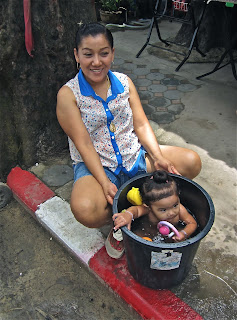
Bath time!
Pickup loads of workers, many from Burma, come to work on construction crews each day. Despite long hours and low pay ($5 a day), they remain surprisingly cheerful.

If you have never experienced the aroma of durian, you will not understand this sign.
The main reason for my trip to Phuket was to teach a three hour biology lesson on animal behavior to 10th graders (M4 in Thailand) at a high school's English Program division for a video series on teaching inquiry science. While I and three colleagues flew down, the camera crew drove for 12 hours with the equipment.
Here, two students test the response of insect larvae to different grains in an experiment they designed. I used the same animals for lessons at three different levels: Primary 4 (4th grade), M2 (8th grade) and M4 (10th grade). The content differed according to the students' experience, scientific skill level and content knowledge.


Phuket town is an old seaport that once saw lots of commerce between the east indies and China. Located just north of the mouth of the Straits of Malacca, it still retains much of the Portuguese architecture which now houses mainly Chinatown shops and Thai businesses.

Traditional Chinese altars are seen on the sides of buildings in the Old Town.

These altars are believed to bring good luck to the inhabitants.

In a Thai "spirit house" sits a serene figure with a pleasant smile. According to one Thai I spoke to, this is probably a well-loved village elder from a past era who now watches over the restaurant where it is located.

If you don't want to pay US$22 (700 THB) for a trip to the airport in an air conditioned minivan ($30, 1000 THB TO Phuket FROM the airport), you can hop one of these "songtaos" (two benches) for $3 (100 baht). It takes longer, and you have to share with other passengers and their bags of groceries, including a bag full of durian that was placed right next to me, but it is the "real" Thai experience. You may have to ask around to find the right one, though.

Many buildings of colonial-era Portuguese design can be found in Phuket Town. Because it overlaps Chinatown, colorful paper lanterns are often part of the decorations.

Motorcycle side cars not only offer ways to transport produce, but families as well. Not safe (although more stable than four on a motorcycle, which is seen often throughout Thailand), but economical.