Visitors do not often see Thailand beyond Bangkok and the seaside resorts. This is true of many foreigners who have lived here for years. If they do, access to Thai culture is limited to what one can see, as language barriers prevent deep understanding. Because of this eventual awareness after a few years of living in Thailand, I realized that my stalled language learning needed a boost if I was to ever get to know the people and Thai culture better. I became intent on understanding and speaking more Thai, so I made a goal of learning at least one new word or phrase every day (and--very important--pronouncing it correctly). It has made a huge difference.
Many Thais who were friendly are now friends, and I enjoy speaking with them on almost a daily basis. What I didn't expect was to have them open up to me as much as some have. Their stories have woven quite a different tapestry of life in Thailand than I had observed, particularly rural Thailand, although some are from the cities, and their history is usually very different.
The following story is one of several that will appear in this blog from time to time. The subject of this post is a woman from a tiny village in the northeast near the Cambodian border. The first time I met her and her sister, one of the first things they said to me was, "We have black skin." I found it odd that first, they would point that out, and second, their skin is nowhere near black, but rather a beautiful light chocolate color. I said that "chocolate is delicious, and vanilla is bua [boring]", which elicited a chuckle. I was to learn that skin color is a very big deal in Thailand, and those with darker skin are looked down upon as having low status. I have to admit that it has bothered me ever since, particularly as a parent of two adopted Thai daughters who have dark skin, one of whom had been teased in school by lighter-skinned Thai kids.
Eventually, I became good friends with the two ladies and often spend time asking them to teach me Thai (in return I teach them English), and in doing so, stories about their lives continue to emerge. Here is one of them, written in a hybrid Thai-influenced English version as I remember hearing it.
"I not finish mataiyom (high school). My mother not have any money to buy choot (clothes) and things for school. When I am young, about 7 year, I get one baht (3 cents) every week for kanom (candy). Sometimes I not get one baht, but if I get one baht, I save it all week to buy something Friday. Sometimes she not give me food to take to school, so I eat din. You know din? (dirt) You ever eat it? It not bad, taste waan (sweet). So I eat it, it free. My father die very young, 37 year old, mother get land, but no money, so she sell some land. I choke dee (lucky), I have some land for house some day, but I not make enough money to make house. Maybe only have land, never house. Family have rice field, have rice one time every year to sell.
"When I am 16 year old, my mother not have money, so I stop school, go to Bangkok to work. I work for Chinese family as mae ban (house maid). I get free room, free food, and 1,200 baht ($37) every month. I think I am rich! I clean house and cook, work every day 12 hour. I do for two year, then I go work at company, make more money but work hard. I make 1,500 baht ($45) every month working 8 hour every day, but not enough so I work two times every day, 16 hour. I do that for 8 year. No time off. I very tired all the time.
"Now I have good job, go to massage school, learn free, now work 10 hour every day, take day off sometime. Pay is okay, but sometime I make only enough for taxi and dinner. But some days I get many lukka (customers) and good tip so can make 800 ($24) or 1,000 baht ($30). Boss take 60%, I keep 40%. I pay 1,500 baht every month for rent, about 200 baht for namfi (water and electricity). I give 3,000 baht to mother and 2,000 baht to loogsao (daughter) every month. She not live with me. Live with her father in Isan (northeast Thailand).
"My life better now, have enough for food and can travel for visiting family."
Next: Living apart from children.
Showing posts with label Thailand village life. Show all posts
Showing posts with label Thailand village life. Show all posts
Saturday, April 26, 2014


Sunday, March 23, 2014
Thailand villages revisited
 |
| Fresh vegetables from the garden will be sold at the local daily morning market. A bunch of long beans sells for 5 baht (15 cents). |
 |
| Construction workers in a small village. The man makes 300 baht ($10) per 10 hour day, the national minimum wage, while the woman makes 200 baht ($6). That is the way things are in rural Thailand. The woman told me she is happy to have the work so she can pay for things her daughter (7 years old) needs for school. |
 |
| A woman proudly displays her beautiful 100% Thai silk. This intricate piece (2 meters long) required 5 days of work. Small village markets in Surin Province have the most sought after Thai silk at very reasonable prices. I bought three. |
 |
| A baby sleeps while her mother shops at the local market. |
 |
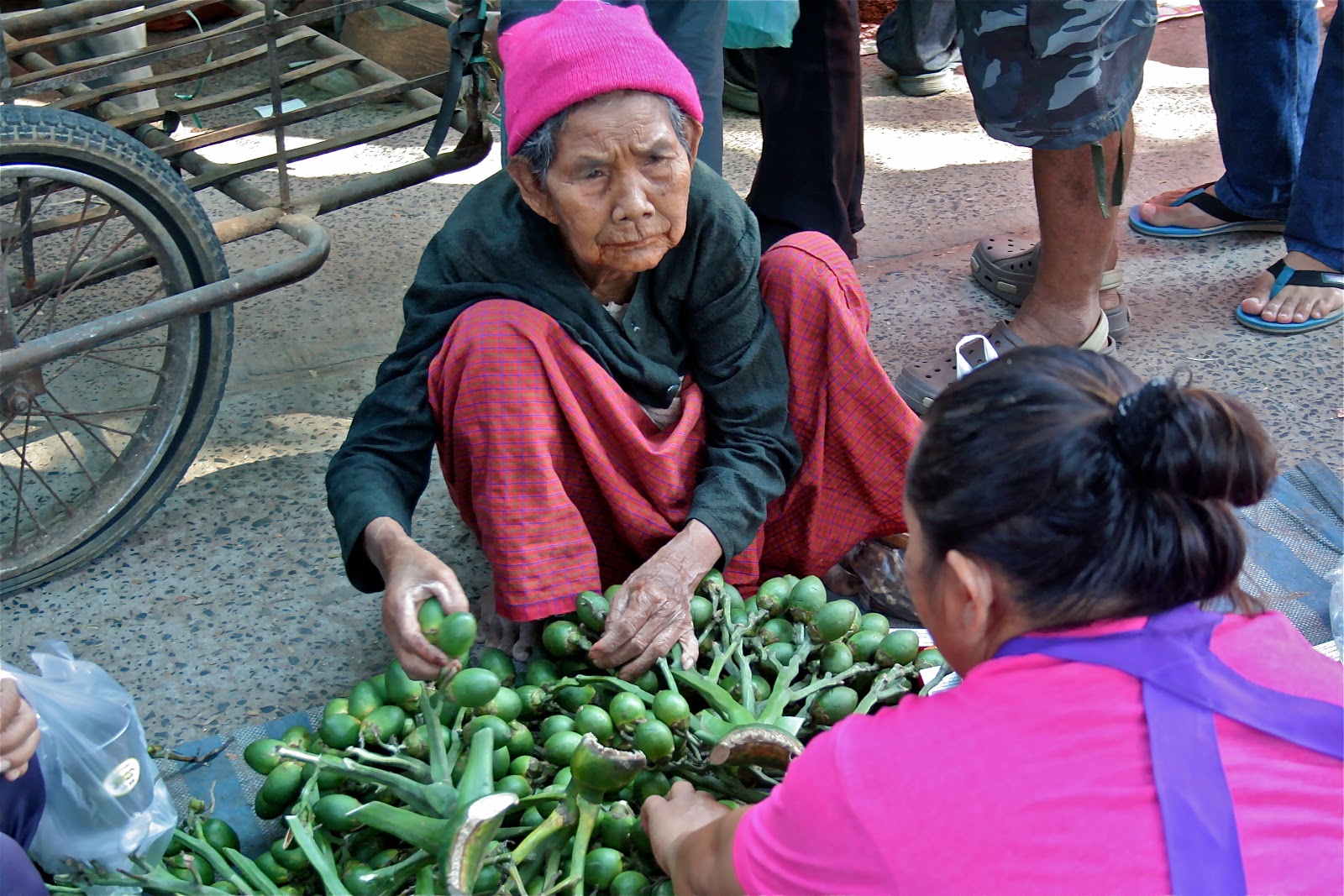
| This woman sells "mahg", the Thai version of betel nuts and does a brisk business. Like many places in Asia, people chew on the very bitter and dry flesh of the nut and frequently spit into, well whatever is available or just on the ground. When I asked why one would want to chew on something that tastes so bitter (I tried it), I was told it is because of the "buzz" one gets, kind of like chewing tobacco (which is also done by many in Thailand). |
 |
| Mahg (Thai betel nut) |
 |
| One can buy herbal cigars at the market. Older people gather herbs to make them using traditional methods. This particular herbal blend is for sinus problems. |
 |
| Every morning at the same time, these monks from the village temple make their rounds gathering alms and then chanting blessings in return. |
Sunday, October 27, 2013
Family farms in Thailand
 |
| Rice nearly ready for harvesting. |
I spent a day touring the fields in northeast Thailand (the region known by Thais as "Isan" or "Esan"), where many different crops are grown by families who live in the nearby village. Plots (or "rai") vary in dimensions, depending on the family's total farm size, and on what type of crop is grown. The season was about to change from rainy (June-October) to dry (November-May), so I was fortunate to see the fields in transition. I plan to go back for the rice harvest in November.
I was not interested in seeing the huge corporate farms here that have become the norm in the U.S., and threaten the way of life of Thai farmers as well, but instead I wanted to see the traditional farms that sustain families. They remind me of the way farming was done in the States 50-100 years ago (I spent many a wonderful summer on my grandparents' small farm in the midwest 50 years ago), although the farms here tend to be much smaller: most Thai farmers grow more than one crop and supplement their income and diets by raising livestock, green vegetables, chili peppers, bananas and coconuts, most of it next to their homes in the village, but some also in the countryside.
 |
| Rice field boundaries are marked by raised earth, to separate each farmer's field, and also for growing different varieties. The fields contain clay, which helps hold rainwater for the rice to grow for several months. |
 |
| Bananas grow as clusters, along field borders and in backyards. Water buffalo, the traditional beast of burden in Thailand, graze on non-rice grasses. |
 |
| Burlap rice sacks. Each holds 90-100 kilos (200-220 pounds). If held until later in the year when demand drives prices up, quality non-chemical aromatic rice from certain provinces can fetch US$18-20 (600-700 baht) per kilo, about US$8-9 per pound. |
 |
| Bagged rice is stored in sheds typically located next to the farmers' houses in the village, not in the fields. Farmers hold their stock depending on market prices or sell quickly if in financial need. These are reminiscent of "corn cribs" in America's heartland. |
 |
| Sugar cane |
 |
| Small herds of cattle are tended by one or two farmers, moving them along roadsides to graze. They sometimes overnight in the countryside, or are taken back to the pens near the farmer's house in the village. |
 |
| Rubber trees |
 |
| Fresh latex, collected year-round |
 |
| Rubber farmers often build simple houses in the grove of trees they tend. No electricity; light is by candles, and warmth provided by campfires during the "winter" (November-January). |
 |
| "Mahn" (taro) |
 |
| Small taro tuber |
 |
| Mahn canes. After harvesting the tubers, the stems are trimmed and those with good nodes for sprouting are stacked to dry. |
 |
| Large mahn tubers being transported for sale |
 |
| Along the roadside between the village and the fields sits a small altar with images of deceased villagers who were successful farmers. People visit this site to pay homage and to bring offerings of food in hopes of a good harvest. |
 |
| Most village farmers do not have mechanized equipment. A few use modern tractors for leveling fields, hauling soil, and transporting produce to market. I asked if they rented them to other farmers and was told, "No, but if you want it, it's for sale!" |
 |
| Many people raise pigs in their backyards or in larger enclosures in the field, in concrete or wooden pens shaded by a thatched roof. Piglets cost about US$45 (1,500 baht) each, and in a few months can be sold for as much as US$225 (7,500 baht). |
 |
| Most farmers sell their produce and meats locally. Here a merchant weighs a chicken that was bought from a local farmer. |
 |
| At home, farmers spend a great deal of time preparing food that they have harvested, tending livestock and making repairs to pens and enclosures. Here, coconuts are cut open for drinking the sweet liquid, and then the soft meat is scraped out. |
 |
| A young woman stir-fries garlic and red onions over a small charcoal cooker. The garlic and onions were chopped on the tree section cutting board next to her. |
 |
| The garlic and onions are pounded together with dried red chili peppers and made into a paste that is stored and used as a garnish with meals. |
Tuesday, February 19, 2013
Thailand Village Life
 |
| Tending a garden in a tiny village in eastern Thailand |
As I learn more about Thai culture, I realize that the nuances are closely tied to life in the small villages around the country. Even in the pulsating metropolis of Bangkok, images of village life are evident, tucked away on side streets among the gleaming high rises and splashy malls. Recent arrivals from upcountry as well as many longtime Bangkok residents bypass the air conditioned mega-malls, fancy western-style grocery stores (there is no Thai word for "grocery store") and restaurants and seek out the small sidewalk noodle stalls and fresh markets.
 |
| Fresh fruits and vegetables at a street market |
 |
| Fresh market. Strawberries from northern Thailand 10 baht (30 cents) per kilo; in the western supermarkets, 700 baht ($20) for California imports. No, the California strawberries do not taste better. |
I have also come to realize that if I want to know more about Thai culture, it is absolutely necessary to speak the language, and to wander through village markets and neighborhoods, stopping to speak to the people who live and work there.
 |
| This man has helped to find and arrest scores of tree poachers in eastern Thailand. |
 |
| A nun with gibbon at a wat (temple) in Isan (eastern Thailand). When asked why she kept him on a rope, she replied, "So he doesn't get caught by poachers in the forest. We have lost many." |
 |
| Bringing a load of sugar cane from the fields to be processed. |
 |
| Fresh market in Isan near the Cambodian border. |
 |
| Market in Surin province. One can hear four languages spoken here: Southern Isan, Thai, Khmer (Cambodian) and Lao. Don't count on having a conversation in English. |
 |
| Mounds of fresh fruits and vegetables at a fraction of the cost in a supermarket. |
 |
| Choosing the best limes. The village market also serves as a meeting place and social center. |
The "simple life" could well apply to the laid back atmosphere in Thailand's rural villages where people may not have much money, and work very hard, but they do have a sabai way of life. When spending time in the villages, it is easy to see why Thailand is called The Land of Smiles.
 |
| Picnic in a truck bed, eastern Thailand |
 |
| Hot chili peppers at an Isan street market |
 |
| Careful grooming, Thai style with tweezers and car mirror |
 |
| Isan farmer |
 |
| Local fermented fruit juices, not found in supermarkets! |
 |
| A grandmother at home in a small village. The house sits raised above the open floor seen here. Village Thais generally sit and sleep on woven reed mats. I met folks who, despite having a bed in their new house, still prefer to sleep on the floor. |
 |
| Village shrimp fisherman with homemade traps |
 |
| Typical village home with tractor, water storage aungs and drying laundry |
One doesn't need to travel far from the city to find village life. The following photos were all taken in Bangkok suburbs where water buffalo still roam and fishermen cast their nets.
 |
| A small shoe repair shop in eastern Bangkok |
 |
| Water buffalo wallow, Bangkok suburb |
 |
| Traditional alms collection by monks each morning in a middle class Thai neighborhood, eastern Bangkok |
 |
| Nurses opt for street food over hospital cuisine. |
 |
| Street market tobacconist |
 |
| Street market food stall |
 |
| Sidewalk amulet salesman |
 |
| Carefully checking amulet quality and authenticity |
 |
| Variety of amulets |
 |
| A happy life on a klong (canal) |
 |
| A fisherman checks his net. Most fish were thrown back ("Gin mai dai," Can't eat them!) including the one in upper left that just received a reprieve when tossed over the fisherman's shoulder. |
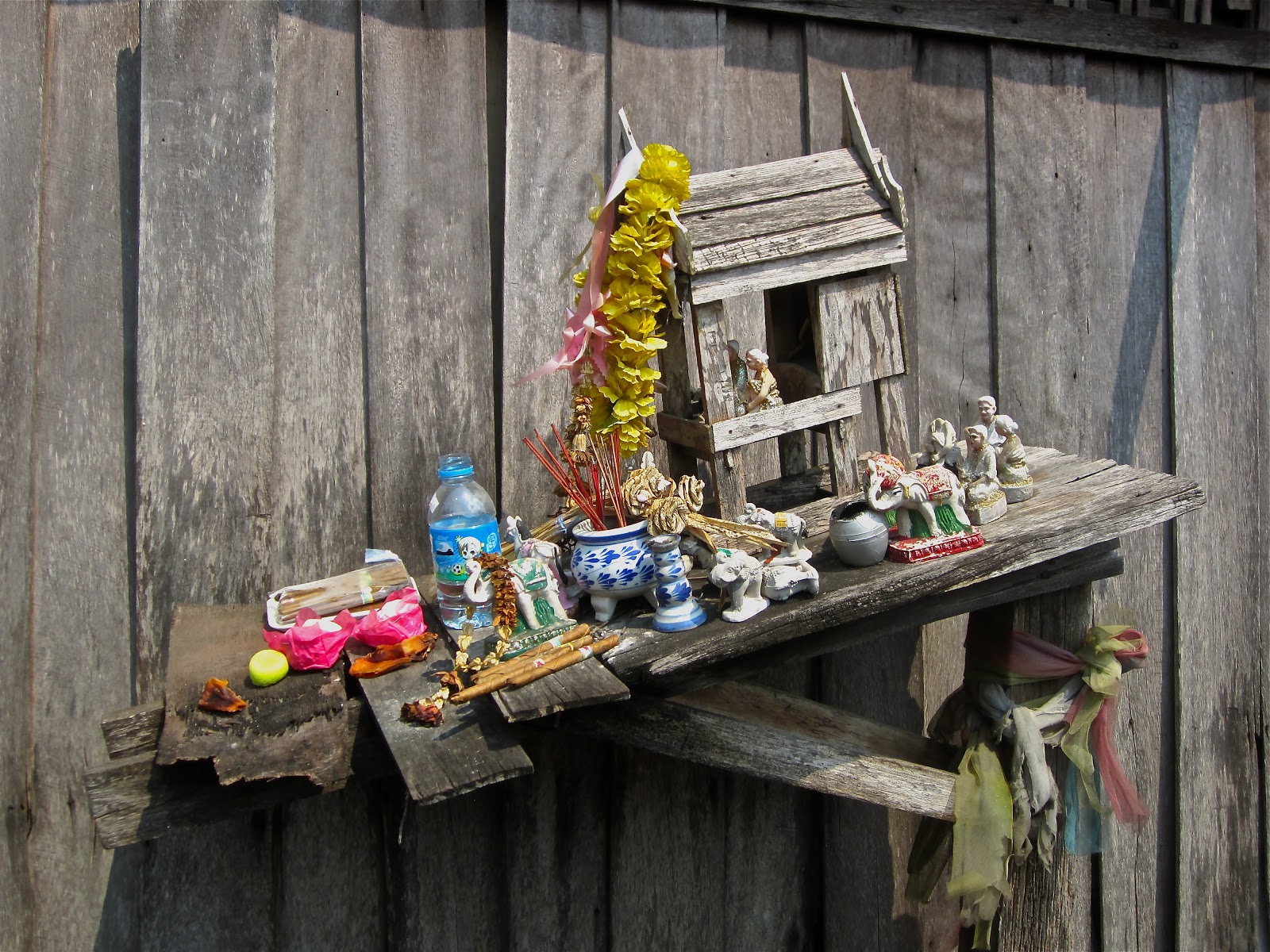 |
| An aged spirit house along a klong in eastern Bangkok |
 |
| Catching a quick nap in the shade at midday. |
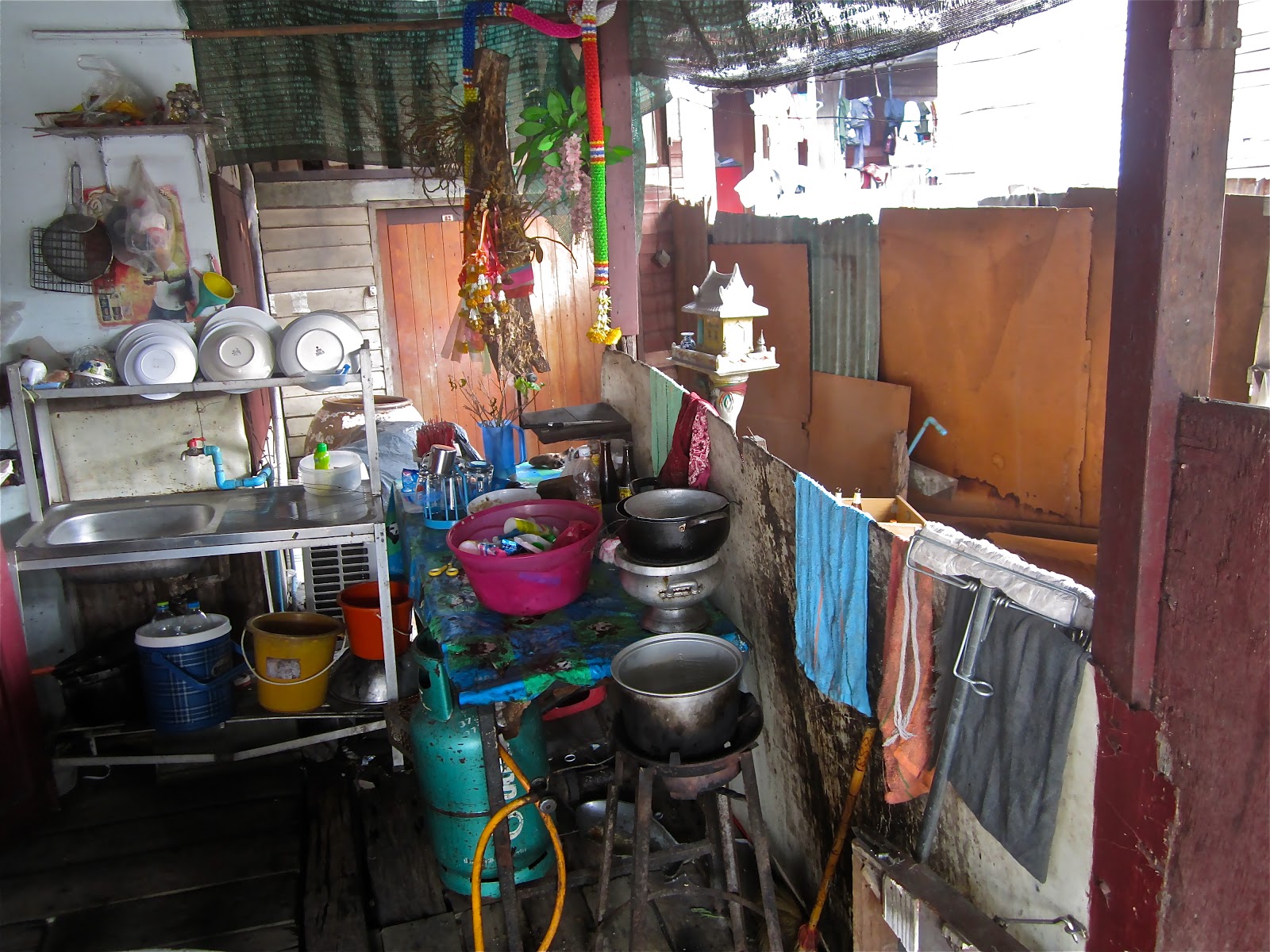 |
| Traditional Thai kitchens were once only found outdoors like this one for obvious reasons in the tropics. New homes enclose the kitchen, and then include air conditioning. |
Subscribe to:
Posts (Atom)